
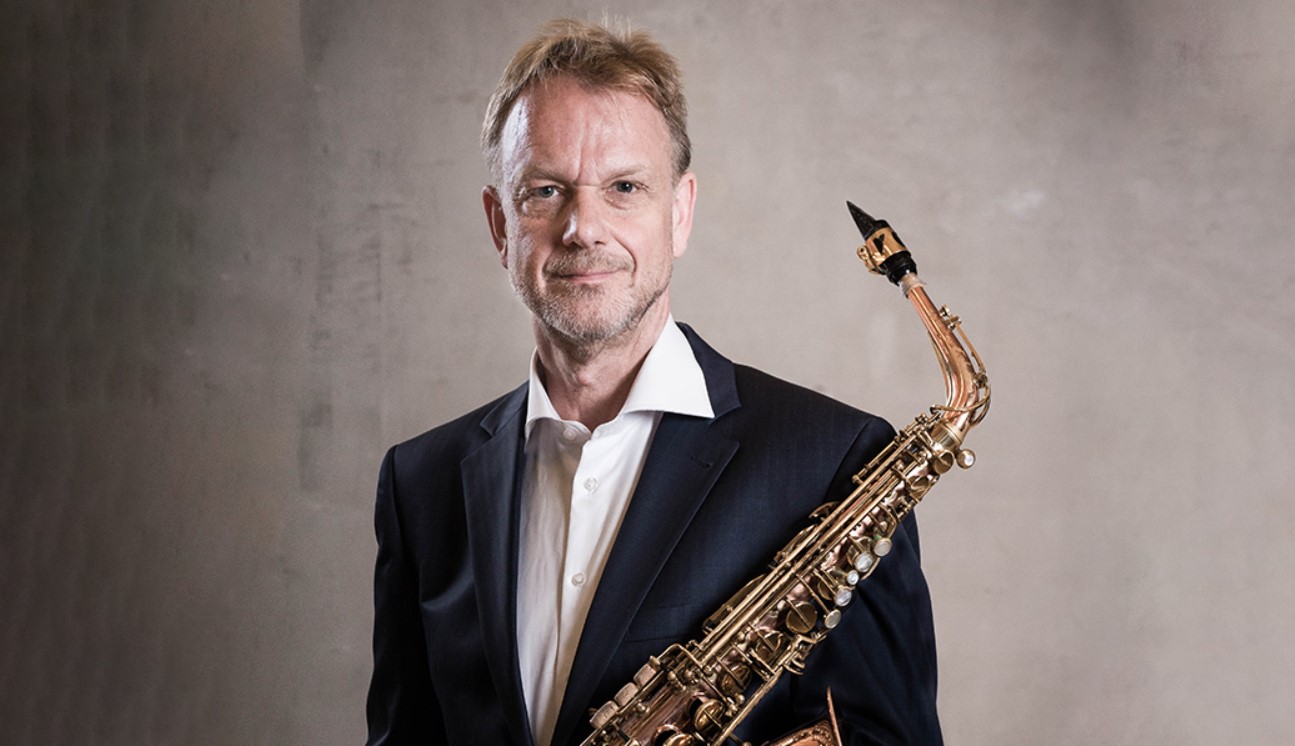
With over 40 years of experience, how do you continue to challenge yourself as a player?
As a player I have always challenged myself to find the sound and the musical imagination that I have in my head. This is a continuous search and still excites me and will maybe always do, in relations to the ensembles that I play in and the music that we choose.
In the last decade I have created various projects with repertoire that was new for me in order to activate this search. In ‘Bach in Image’ (in collaboration with video artist James Murray) the idea was to (hopefully) understand and present the music for solo instrument by J.S. Bach. In order to do that I had to learn to think differently than I was used to (more ‘vertical’ than ‘horizontal’) and combine that with my own expression. That was a huge challenge (on soprano, alto and baritone) that took me roughly 10 years before I dared to record it on a CD.
The baritone saxophone has become more and more a fascination to me (supported as I feel by owning a beautiful Selmer Mark VI with low A and high F#) and that lead to the project ‘Little Big Horn’ in which I presented (together with dramaturgist André Arends) a multimedia performance with 7 new pieces for baritone saxophone. I can tell you that now the baritone has a lot less secrets for me than before and I was happy to show that on the CD ‘Folies de Baryton’. The last CD that I recorded consists music by the French composer Henri Sauguet: I believe that this master should be more known for his music and with some great colleagues I could record an entire CD with his music.
So, resuming, I always look for new musical projects in order to show my musical ideas.
At the moment my focus is on a new program with the Duo Calvadoré (with pianist Jan Lust) around music from the ‘Roaring Twenties’ on several of my old horns. Next to that I am happy to play concerts with my TRIO ABRIL (with fellow saxophonist Juani Palop and pianist Frank van de Laar). We are focusing on getting new pieces for this beautiful ensemble form (Guillermo Lago, Santi Baez, Carlos Michans, Klaas de Vries etc.) so enough new notes to conquer!
With so many generations of students, what’s something that has remained constant in your teaching approach? And what has changed?
What has stayed in my teaching is that I want to share with my students the beauty of bringing musical imagination to life and provide them with the tools to do that. In this way I have been able to (and still am able to, I hope) pass my experience through to new generations of players. And I think, that in the fundament that didn’t really change in the deeper musical meaning: I am always fascinated what the sequence of notes is creating in terms of ‘language’ and how that refers to the player and the instrument.
But it is not only this aspect: generally spoken it has become more and more important to create a meaningful context in which to perform music, for instance the ‘good old’ thematic programs, but also even more ‘out of the box’ interdisciplinary contexts. This is simply what the actual musical business is asking for from the actual independent musician and ensembles. I like to help my students to develop their thinking process in this direction.
In 4 decades the repertoire that young players play has changed. Regarding to this we have now a whole vast collection of newly composed music. Also, compared to when my career started, saxophone players are much more into playing transcriptions and arrangements of music for other instruments (a development in which I played my own humble role). This means that as a teacher I feel that I have to be proficient in many more styles (Baroque, Romantic etc.) than just the regular ‘saxophone music styles'. For me this is a very interesting aspect of my work.
Another element that has changed is the taste of the (young) saxophone player. For instance: the sonatas by for instance Fernande Decruck and William Albright were rarely performed 30 or 40 years and even put aside as non-relevant (especially in the case of Decruck). Nowadays we see, that a lot of people play them and that these pieces appear regularly on competition programs. So if I want to help my students prepare these competitions, I have to teach this rep, although I am not very fond of it.
Speaking about competitions: this element lately has become very popular in the musical world and we also see many saxophone competitions appearing, often within the format of a festival. I think that it is great that young saxophonists get the opportunity to meet with each other and with jury members on those occasions. Nevertheless I would like to emphasize that the musical world needs creative minds and encourage young players to think about how to develop their own taste and think about how to obtain concerts and design good programs.
On a general cultural level the big change with the beginning of my career is the presence of social media. This has changed the whole idea of visibility and audibility for musicians. It is for every individual to decide how to deal with this element in a meaningful way. Personally I feel that I want to stay away from putting an overload of information online: I want to avoid to be ‘rand.
If you could go back in time and give one piece of advice to your younger self as a saxophonist, what would it be?
Sometimes I can see my (former) students having a conflict in their working relationships. Nowadays I usually advise them to find a way to start a good and open conversation about the bottlenecks and thus try to find a solution or, at least, get one step further in the good direction. I would ‘advise my younger self’ to do this in tricky situations rather than just going on in the same way and speculate on and hope, that the situation will solve itself.
What makes Eibarsax special to you? What do you hope participants take away from it?
The teacher team of Eibar is what the course makes special to me. I am sure that with these fantastic musicians/teachers we can build a very beautiful ambiance and work atmosphere. And from that base I am also sure that we can do a good and meaningful work with the participants.
If your saxophone had a superpower, what would it be?
When I was a kid I played the clarinet. Maybe you know that the clarinet has two different intermediate pieces (between the mouthpiece and the highest part of the body): the main difference is the length of these two intemediate pieces. This makes it possible for the player to react on the different tunings around: in the US for instance we encounter usually 440 Herz and in Europe mostly 442. So:it would be great if the big saxophone marks could start thinking about creating something similar for the saxophone (two different necks with different lengths and characteristics) in order to react on this issue. Personally, being mainly active in Europe, I face a big challenge playing in tune in a satisfactory way, when I perform in the States for instance. I would like to experiment with this idea.