
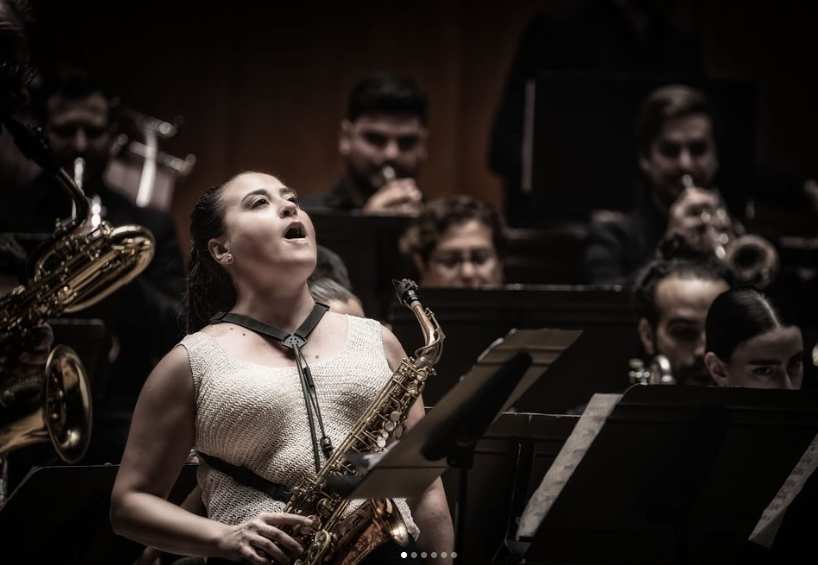
You have played in many ensembles. What do you think makes a great chamber musician?
A great chamber musician must listen more than they play. Through experience and a certain skill, you have to be able to serve whatever is happening around you and act accordingly. That doesn’t mean being passive—quite the opposite: knowing when to take the initiative and when to serve another person or voice.
To be «at the service of», to recognise what the music needs and act on it, you have to develop your imagination to the fullest and learn how music works from the inside.
That lets you know what role you have to assume at every moment, because that role truly changes constantly: things like dynamics, agogics and intonation stop being something solid and become something fluid, adaptable.
The ability to maintain that fluidity within a musical discourse that has aesthetic consistency and a solid technical basis is, in my opinion, the soul of chamber music.
Another thing I find super important for chamber work is the ability to give and receive feedback, to accept what your colleagues tell you with sportsmanship. You need to keep your feet on the ground and not have an inflated ego—one of those that later deflates and ends up empty.
It isn’t about having no ego, opinions, tastes, or preferences, but about finding an inner balance, having a well‑adjusted self‑image, so you can withstand the constant mirror that chamber music is.
If you could be a student again, what advice would you give yourself?
«If I were a student again, the advice I’d give myself would be: don’t focus only on the saxophone. Remember to eat well, exercise, stretch. And look at yourself in a more holistic sense.
Trust that this will bring you many benefits and that this is a long‑term career. It’s not about winning this or that competition. That’s important, but what matters most is that you can maintain good mental, physical and emotional health over the years.
To avoid burnout and keep enjoying what you do, pay attention to your body and your nutrition. Habits like drinking more water, not eating so many sweets and carbs, going out every day for at least an hour even if it’s just for a walk, doing something aerobic—running, cycling, anything that keeps you active.
And, above all, don’t act out of desperation. Know that after today there is also tomorrow.
At school they never taught me this. I would cram the night before, pull an all‑nighter, get an eight out of ten, and then forget everything.
With the saxophone I wasn’t that extreme, but I also didn’t know how to study with a mid‑ or long‑term view. I didn’t understand that «I’m going to study two hours every day and trust the process».
I learned that here in the Netherlands, watching my Japanese and German friends.
They simply knew what they had to do, did it every day and that’s it. They trusted a long‑term process, and the results I witnessed completely revolutionised my way of thinking.
They simply knew what they had to do, did it every day and that’s it. They trusted a long‑term process, and the results I witnessed completely revolutionised my way of thinking.
That leads to a disconnection between our inner world and what we’re supposed to be doing. That connection is absolutely vital to carry out creative processes like ours.
In Spain, I think that mentality is harder for us. We’re taught to give everything in a short time, but in reality, if you study an average of an hour and a half a day for a year, you advance more than if you spend three months studying five hours a day without rest—and maybe you’re happier.
I’d also tell myself: listen to yourself more.
Find out when you’re most lucid and take advantage of those moments. And also identify when you need to rest and allow yourself to do so.»
What is something you always try to transmit to your students?
«In general I spend a large part of my teaching removing interferences:
Mental: Something I see a lot in my students is that their musical imagination is far more developed than what they can pour into the saxophone at a given moment.
I try to help them connect that imagination with what they actually play; I try to make the fact of having the instrument in their mouth not block them, but let them express themselves freely.
Physical/technical: Tensions in the embouchure, tensions in the throat—things that aren’t working and keep them from playing and conveying their ideas properly.
For me, it’s fundamental to help them eliminate those interferences so there is a healthier energy exchange between them and the music they want to make.
That they can release the air naturally, connect their imagination with the instrumental elements.”
What excites you most about the first edition of Eibarsax?
«What excites me most about Eibarsax is the opportunity to learn from my colleagues and from the students, hopefully to pass on to new generations what I’ve learned over the years and help them on their own path.
I’m also very excited to play in one of the evening concerts and share that moment with everyone.
I’m excited to share, and to do so in a schedule and structure designed with time and physical spaces so we don’t burn out—so we can not only give energy but also receive it.
I’m really looking forward to hearing my colleagues’ concerts and the students’ concerts; it’s almost a mixed role, that feeling of being half teacher, half student, because I expect to learn a lot from my colleagues, from the students, from whatever happens and from the synergies that arise during the week, so I’m also excited as the eternal learner I consider myself.»
If your saxophone could talk, what would it say about you?
«I think my saxophones would have good words for me, because I try to stay connected to them when I play.
A long time ago I stopped going against the instrument—mentally, emotionally, or technically. I always try to go with the instrument.
I think if my saxophones could talk, they’d say something like:
“Juani is a good travel companion, a partner in crime with whom we can always connect one way or another."
I also think my saxophones are entertained by the musical things I tell them and by everything I invent for them.
So yes, I think they’re entertained, they have fun, and in some way we give life to each other.»